 CallPal
Connect CallPal to HubSpot
Sync your HubSpot contacts, companies, deals and tickets into CallPal, call them from the browser, and have every call written back as a native HubSpot call. Setup takes about two minutes.
Deciding whether to use it at all? What the HubSpot integration does.
Before you start
- A CallPal account. The 14-day trial is enough — no card required, and the integration is available on every plan.
- A HubSpot user allowed to install apps into the account. That normally means Super Admin.
- In CallPal, permission to manage integrations. Owners and admins have it by default.
Open Integrations in CallPal
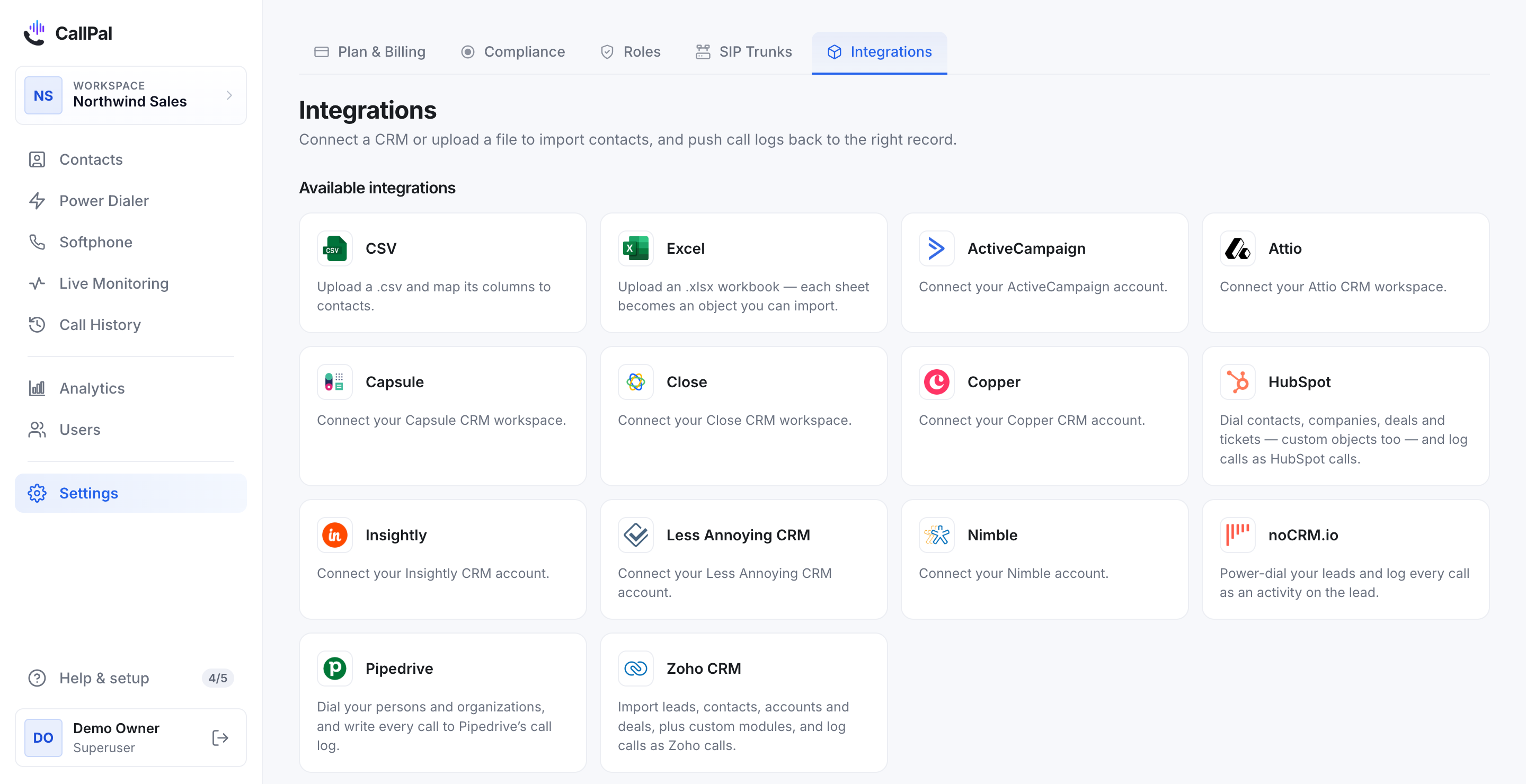
In CallPal, go to Settings → Integrations, find HubSpot, and select it.
Approve access in HubSpot
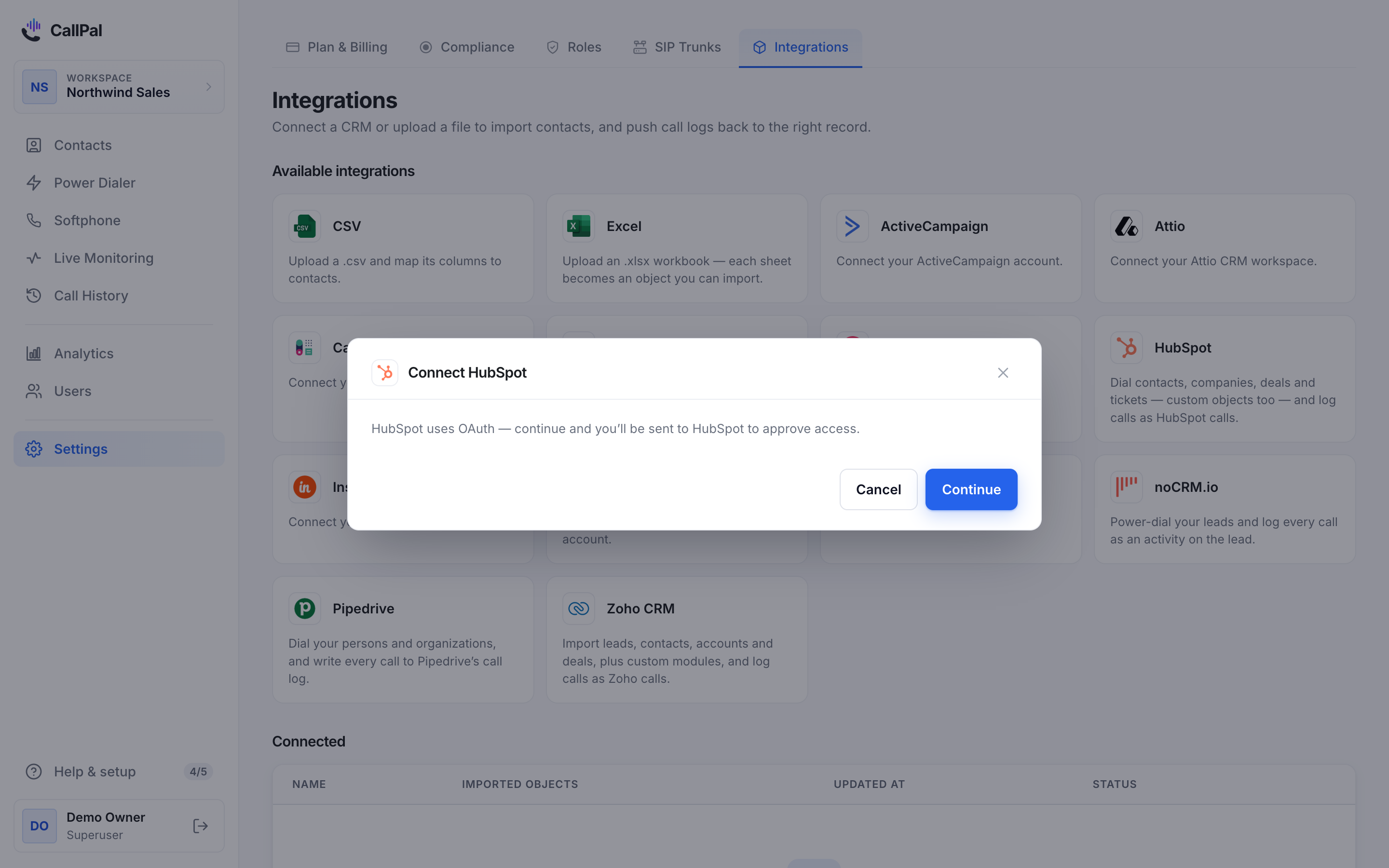
HubSpot connects over OAuth. Select Continue and CallPal sends you to HubSpot, where you choose which account to connect and approve the access being asked for.
If you have more than one HubSpot account, the account picker appears here — choose carefully, because the connection is to that account and changing it later means reconnecting.
Choose what to import
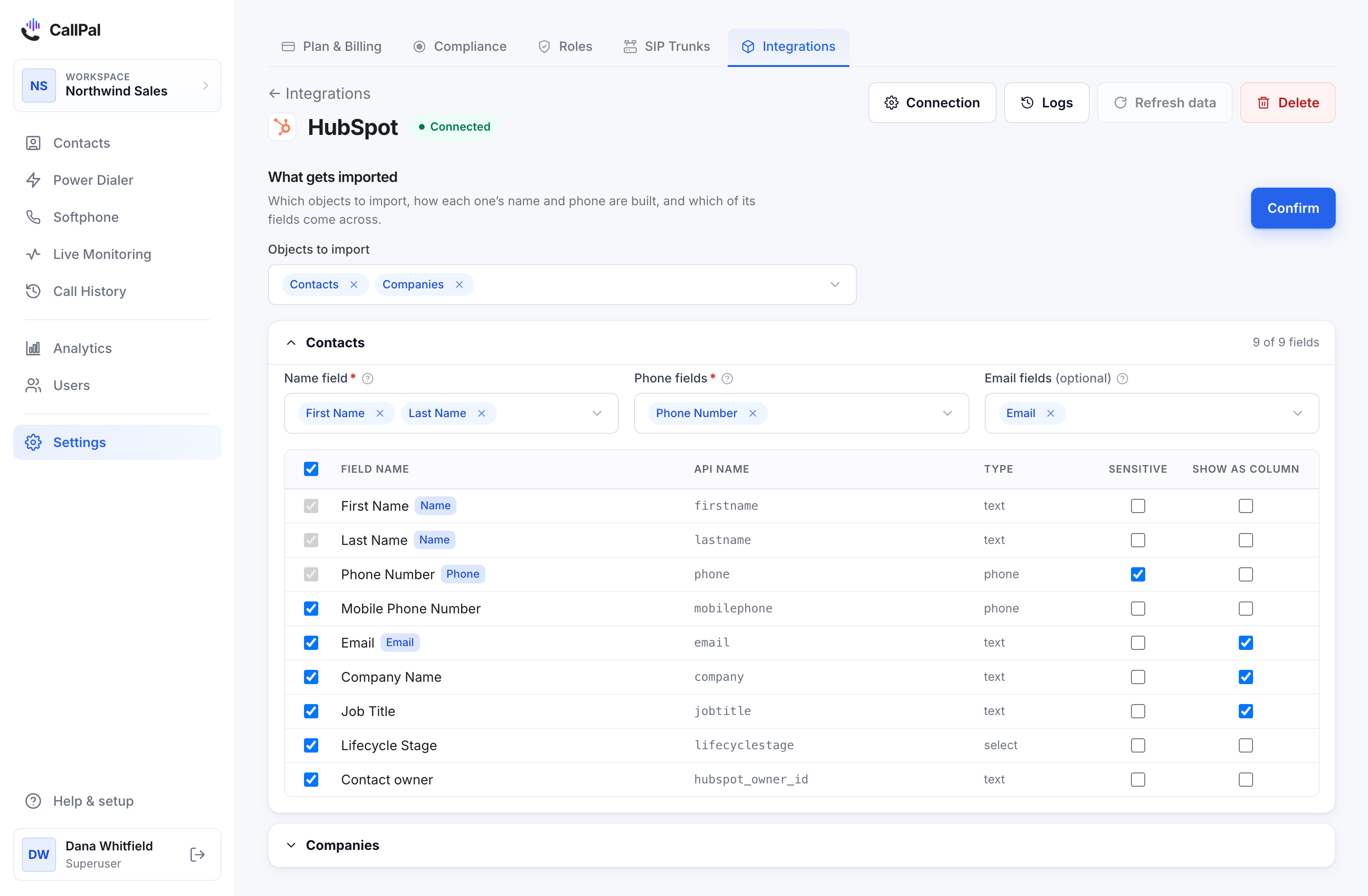
Contacts is selected for you. Companies, Deals and Tickets are available too — tickets matter if your team calls people back about open issues rather than about new business.
Custom objects are supported. CallPal reads the object and property list from your own portal, so anything you have modelled in HubSpot appears here alongside the standard four.
Check the field mapping
For each object, CallPal reads its properties from your portal — custom properties included — and asks which hold the name, the phone numbers and the email.
HubSpot commonly carries both
phoneandmobilephone. Map both if your reps should try either, and put them in the order you want them tried.Run the first sync
Start the sync. Records appear as they arrive, so a large portal fills in progressively rather than showing nothing until it finishes.
After that CallPal re-syncs every 30 minutes, and you can trigger one by hand from the connection page.
Make a call
Open any synced record and select the phone number, or add records to a power-dialer campaign to work a list.
When the call ends, CallPal writes it as a native HubSpot call engagement on the record — so it shows on the contact timeline, counts in HubSpot’s call reporting, and can trigger workflows the same way a call logged in HubSpot would.
What syncs
- HubSpot → CallPal
- Contacts, and optionally Companies, Deals, Tickets and any custom objects. Standard and custom properties alike, read from your own portal.
- Calls → HubSpot
- Every completed call is written as a native call engagement on the matching record: direction, duration, outcome, start time and a link back to the call in CallPal.
What it does not do
Worth reading before you roll this out to a team — these are design decisions, not gaps we are about to close.
- CallPal reads your records and does not edit them. The only thing written back is the call engagement — never a property, a lifecycle stage or a deal.
- Calls from custom objects are not written back. Custom objects import and can be dialed, but HubSpot has no standard way to attach a call to one, so those calls stay in CallPal’s call history. Calls from contacts, companies, deals and tickets are logged as usual.
- No sequences, no email, no marketing. CallPal is the calling half only; HubSpot keeps doing everything else it does today.
- CallPal is outbound only. No inbound routing, no IVR, no predictive dialing.
Questions
Do I need to create a private app in HubSpot?
No. CallPal is an OAuth app, so you approve it from your own portal and nothing needs creating in HubSpot’s developer tools.
Will it work with custom objects and custom properties?
Yes. CallPal reads the object and property list from your portal rather than a fixed list, so both appear in the mapping alongside the standard ones. Calls made from a custom object are the one thing not written back to HubSpot; they stay in CallPal’s call history.
How are calls recorded in HubSpot?
As native call engagements on the matching record — so they appear on the timeline, count in HubSpot’s call reporting, and can trigger workflows.
Can I connect more than one HubSpot account?
Each connection is to one portal. Connect again to add a second, and choose the right account on HubSpot’s picker during approval.
Which phone number does it call from?
Your own. CallPal is bring-your-own-carrier: you connect your own SIP trunk, calls are billed by your carrier at your rate, and outbound calls present your company number rather than a rep’s personal line.
How do I disconnect it?
Delete the connection in CallPal, or remove CallPal from Connected Apps in HubSpot. Either stops the sync immediately; records already in CallPal stay there.
Still stuck?
Write to [email protected] with your account name and what you saw. A person answers.