CallPal
Recorded-call review is the backbone of sales coaching and it has one structural weakness: it is always too late. By the time a manager hears the call that went wrong, the deal is cold, the rep has made the same mistake nine more times, and the feedback arrives as a verdict rather than as help.
Live monitoring closes that gap. It also, handled carelessly, does more damage to a team’s trust than any amount of bad feedback. This is what the three controls do, when each is the right one, and the rules that keep the second outcome from happening.
The three controls
| Control | Rep hears you | Customer hears you | Use it |
|---|---|---|---|
| Listen | No | No | Routinely |
| Whisper | Yes | No | When the call is about to be lost |
| Barge | Yes | Yes | Almost never |
Listen — the default
A silent third leg on the call. Nobody hears you and nothing about the conversation changes. This is where 90% of live monitoring should happen: a manager listening to two or three calls in a row before a coaching session, so that the feedback is about this week rather than about a recording from a fortnight ago.
Its real advantage over recordings is not immediacy but sampling. A recording library invites you to review the calls that already went wrong; listening live gives you an unbiased sample, including the ordinary calls where the small habits live.
Whisper — the rescue
Audio to the rep only. The customer hears nothing. Used well it is one short sentence: "ask about their renewal date", "that price is out of date", "wrap up, they said they are driving".
Used badly it is a running commentary in the ear of someone trying to hold a conversation, which is genuinely harder than doing either task alone. The discipline is one intervention per call, and only when the alternative is losing something. If you find yourself whispering on most calls, the problem is upstream in training, and the whisper is a way of not fixing it.
Barge — the emergency brake
You join the call as an audible third party. The customer hears you appear. There are three legitimate reasons: a new rep is about to give incorrect information that is expensive to walk back, an escalation genuinely needs authority the rep does not have, or the call has become abusive and the rep needs someone else in the room.
Everything else is a manager wanting to take over, and it costs more than it gains — it tells the customer the rep is not trusted, and it tells the rep the same thing in front of a customer.
The rules that keep this from becoming surveillance
Live monitoring is a capability with an obvious failure mode. Four rules cover most of it.
1. Tell the team, in writing, before you switch it on
Who can listen, under what circumstances, and what happens to what they hear. A team that discovers monitoring by accident will reasonably conclude they were being watched in secret, and you will not get that back. In several jurisdictions employee notice is a legal requirement rather than a courtesy — check yours.
2. Coach from patterns, not from one call
Anyone sounds bad on their worst call of the week. Feedback drawn from a single overheard moment is both unfair and useless; the same observation across four calls is a coaching point the rep can actually act on.
3. Say when you were on the call
"I listened to two of your calls this morning" costs nothing and removes the entire question of whether monitoring is covert. Managers who do this find reps start asking to be listened to before a difficult call.
4. Keep the trail
Every listen, whisper and barge should be logged with who did it and when. This protects the rep, who can see the record, and it protects the manager, who can show that the capability was used as described. A monitoring feature with no audit trail is a liability wearing a feature’s clothes.
A weekly routine that works
- Twenty minutes, twice a week, listening only. Pick a time when the floor is busy and listen to whoever is live. Take notes; intervene in nothing.
- One theme per rep per week. Not a list of nine observations. One: the opener, the pause before the price, the way discovery questions turn into a pitch.
- Pair it with one recording. Live listening finds the pattern; a recording lets you both hear the specific instance. The two together are far better than either.
- Whisper only on live deals. If the call does not matter, let it go wrong and talk about it afterwards. Rescuing a low-stakes call teaches nothing.
- Review your own barge count monthly. If it is above zero most weeks, something is wrong with enablement, not with the reps.
How this works in CallPal
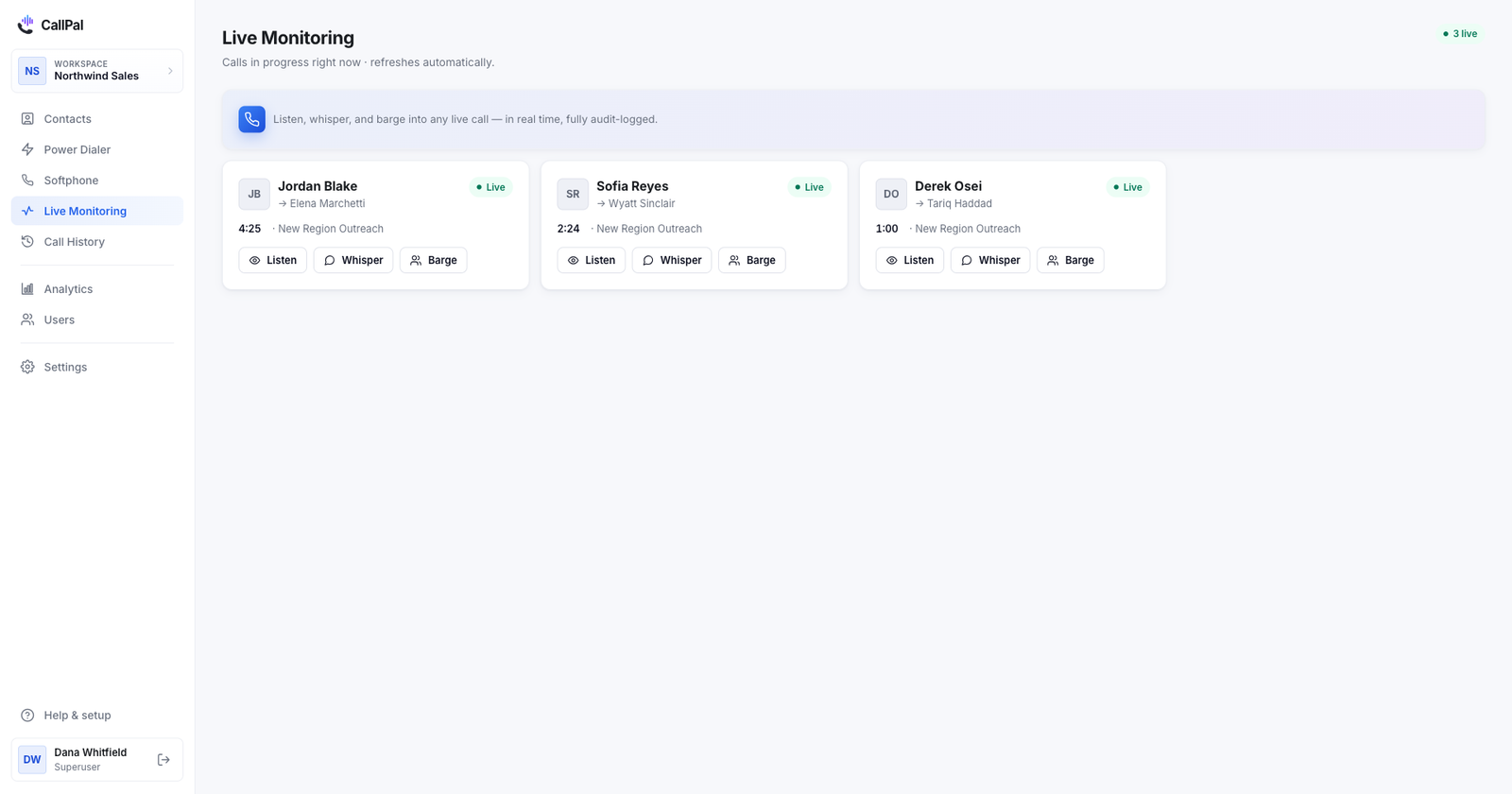
The live monitoring board lists every call in progress across the workspace with the rep, the contact and a running timer, and offers listen, whisper and barge per call. It is on the Scale plan, gated by permission rather than job title, and every supervision action is written to the audit log with the actor and the call it touched. See live monitoring for the detail.