CallPal
A cold call is decided in the first ten seconds, and not by your value proposition. In those ten seconds the person you called is answering one question: is this worth the next thirty seconds of my life? Nearly every bad opener fails because it answers a different question — usually "who are you and what do you sell?", which nobody asked.
Below are seven openers that work in different situations, the structure they share, and how to handle the four objections that end most calls. Treat them as scaffolding. A script read verbatim sounds like a script, and people hang up on scripts.
The structure underneath all seven
- Name yourself and your company. Immediately. Anonymity reads as a scam call and buys nothing.
- Acknowledge the interruption. One clause. It signals you know this is a cold call, which is more disarming than pretending otherwise.
- Give a reason this call is about them. Not what you do — why you called *this* person. This is the part that earns the next thirty seconds.
- Ask one question and stop talking. Silence after a question is the most underused tool in cold calling.
Every opener below is that shape with a different third step. When one stops working, change step three and leave the rest alone.
The seven openers
1. The permission opener
“Hi {name}, it’s {you} from {company}. I know I’ve caught you out of the blue — can I have thirty seconds to say why I called, and you can tell me to go away?”
The workhorse. It gives back the control the call took away, and the explicit exit makes it easy to say yes to. Say the thirty seconds and mean it — if you are still talking at forty-five, you have taught them not to trust the next thing you say.
2. The trigger-event opener
“Hi {name}, {you} from {company}. I saw {specific event — you opened a second location / you’re hiring three more field techs}. I called because that usually creates {specific problem}. Is that landing on you?”
The highest-converting opener when the trigger is real and recent. It has one failure mode: a vague trigger ("I saw you’re growing") is worse than none, because it advertises that you did no research while claiming you did.
3. The referral opener
“Hi {name}, {you} from {company}. {Colleague} in {department} suggested I speak to you about {topic} — is that you, or have I got the wrong person?”
Borrowed credibility, and the strongest opener you have. It must be true. An invented referral, discovered, ends the account and takes the colleague’s goodwill with it.
4. The problem-first opener
“Hi {name}, {you} from {company}. We work with {similar role} at {similar companies}, and the thing that comes up almost every time is {specific problem}. Before I take any more of your time — is that a real problem for you, or have you got it handled?”
Use when you have no trigger and no referral. It works only if the problem is specific enough that a wrong guess is possible; a problem nobody could deny having ("keeping costs down") signals nothing.
5. The straight-shooter opener
“Hi {name}, this is a cold call — do you want to hang up, or give me twenty seconds?”
Polarising and surprisingly effective with senior people, who have heard every softer version. It requires you to actually be interesting in the next twenty seconds, so do not use it as a shortcut past preparation.
6. The reconnect opener
“Hi {name}, {you} from {company}. We spoke back in {month} and you said the timing was wrong because of {reason}. I’m calling because {that reason has changed / it’s been six months}. Is it worth another look?”
The most neglected list in most CRMs is the one marked closed-lost. This opener only exists if someone wrote down the reason at the time — which is an argument for call notes landing on the record automatically rather than depending on discipline.
7. The wrong-person opener
“Hi {name}, {you} from {company}. I don’t think you’re the right person for this, but I’m hoping you can point me at whoever owns {area}. Who should I be speaking to?”
A navigation tool, not a pitch. It works because people who are not being sold to are usually happy to help. Do not pivot into a pitch if they turn out to be the right person — you just told them they were not, and they noticed.
The four objections that end calls
“I’m not interested”
Almost always a reflex fired before you finished your first sentence, not a considered position. Acknowledge and ask one narrow question: *"Completely fair — you’ve no idea what this is yet. Can I ask one thing and then leave you alone? Is {problem} something your team deals with today?"* One attempt. A second is harassment.
“Send me an email”
Sometimes genuine, usually a polite exit. Take it, but extract something first: *"Happy to. So I don’t send you something useless — is the issue more {A} or {B}?"* Then send a short email that references what they said and includes a specific next step. Log the answer against the record so the reconnect opener has something to stand on.
“We already use {competitor}”
Good news: they buy this category. Do not attack the incumbent — you will be arguing with a decision they made. Ask instead: *"That makes sense, they’re good at {genuine strength}. Out of curiosity, what would have to be true for you to look at something else?"* The answer is either "nothing", which frees your time, or a list of what to build a case around.
“I don’t have time”
The easiest to handle and the most often fumbled. Believe them, and book the alternative: *"Of course. Is tomorrow morning better, or should I try next week?"* A binary choice books far more callbacks than "when suits you?", which asks a busy person to do work.
How to know whether your script is working
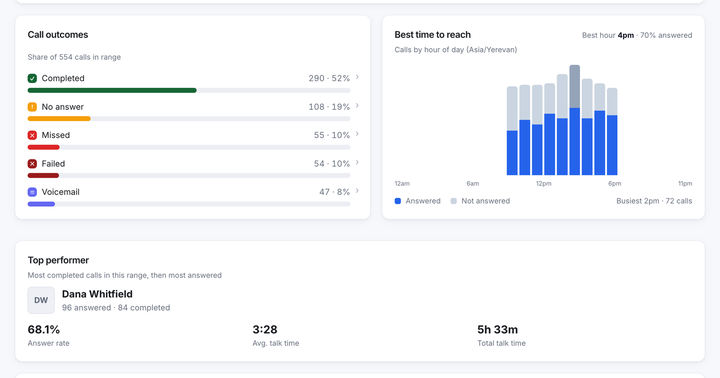
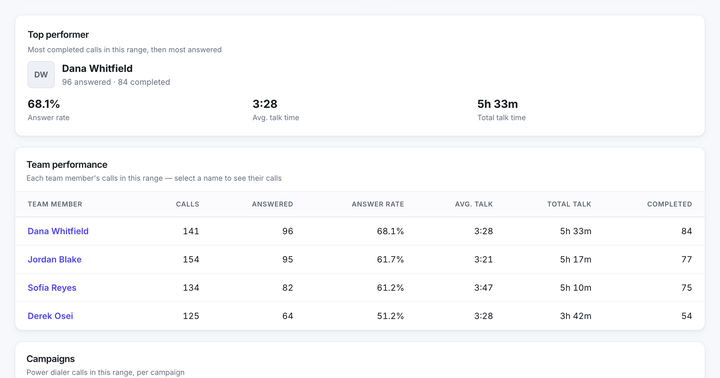
Do not judge an opener on how it feels. Judge it on conversation rate — the share of answered calls lasting longer than sixty seconds. That is the number an opener directly controls; meetings booked is downstream of the whole call and moves too slowly to attribute.
- Run one opener across at least a few hundred answered calls before drawing a conclusion.
- Keep the list source constant. Changing the opener and the list at once tells you nothing about either.
- Have every rep run the same opener during the test, even the one who hates it. A test where the sceptic runs their own version measures enthusiasm.
- Listen to ten calls, not the transcripts. How something is said carries most of the effect, and it is invisible in text.
The metric definitions are in 12 outbound sales KPIs that actually predict pipeline, and the live-listening habit that makes call review sustainable is in the call monitoring playbook.