CallPal
Most calling platforms sell you two things bundled together: the software, and the phone service underneath it. You pay a seat price and a per-minute rate, and the numbers you use belong to the vendor. It is simple, it works on day one, and the second half of that bundle is where a surprising amount of money goes.
BYOC — bring your own carrier — separates them. You hold a contract with a wholesale voice provider, and the calling software authenticates to that provider and drives it. The vendor never touches a minute of your traffic and never bills you for one.
What a SIP trunk actually is
A SIP trunk is a credentialed connection between your calling system and a carrier’s network. Practically, it is a hostname, a set of credentials or an allow-listed IP address, and a set of phone numbers (DIDs) the carrier has assigned to you. Your system says "connect me to +1 555 010 4477 and present +1 617 555 0142 as the caller"; the carrier does it and adds the minutes to your bill.
The word "trunk" is inherited from the analogue era, where it meant a physical bundle of lines with a fixed capacity. The concept survives as a channel limit: how many simultaneous calls your trunk permits. Ten reps who might all be talking at once need at least ten channels.
The arithmetic
Wholesale US outbound termination is commonly quoted around three-quarters of a cent to about a cent and a half per minute, depending on volume and destination mix. Bundled platform rates are typically several times that, or folded into a per-seat bundle of included minutes with overage priced well above wholesale.
The number that matters is your monthly minutes. Reps × dials per day × average talk time × working days — or put your own figures into the call cost calculator:
| Team | Approx. minutes/month | At ~$0.01 (BYOC) | At ~$0.03 (bundled) | Difference |
|---|---|---|---|---|
| 3 reps, 40 dials/day | ~5,000 | $50 | $150 | $100/mo |
| 8 reps, 60 dials/day | ~20,000 | $200 | $600 | $400/mo |
| 20 reps, 70 dials/day | ~60,000 | $600 | $1,800 | $1,200/mo |
Two conclusions fall out. Below roughly 5,000 minutes a month the saving is real but small enough that convenience may win. Above about 20,000 it starts to exceed what you pay for the software itself, and the question flips: why is the dialer vendor in the telecom business at all?
What you take on
BYOC is not free. You are absorbing three jobs the bundled vendor was doing.
A carrier relationship
Choosing a provider, opening an account, passing their onboarding checks, and having someone to email when call quality drops on a Tuesday. Modern wholesale providers self-serve most of this, but it is still a vendor you own.
Number registration and reputation
In the US this is the part teams underestimate. Caller-ID authentication and analytics mean an unregistered number dialing at volume can start arriving labelled as spam within weeks. Your carrier provides the registration path; using it is on you, and skipping it silently destroys your answer rate.
Capacity and failover
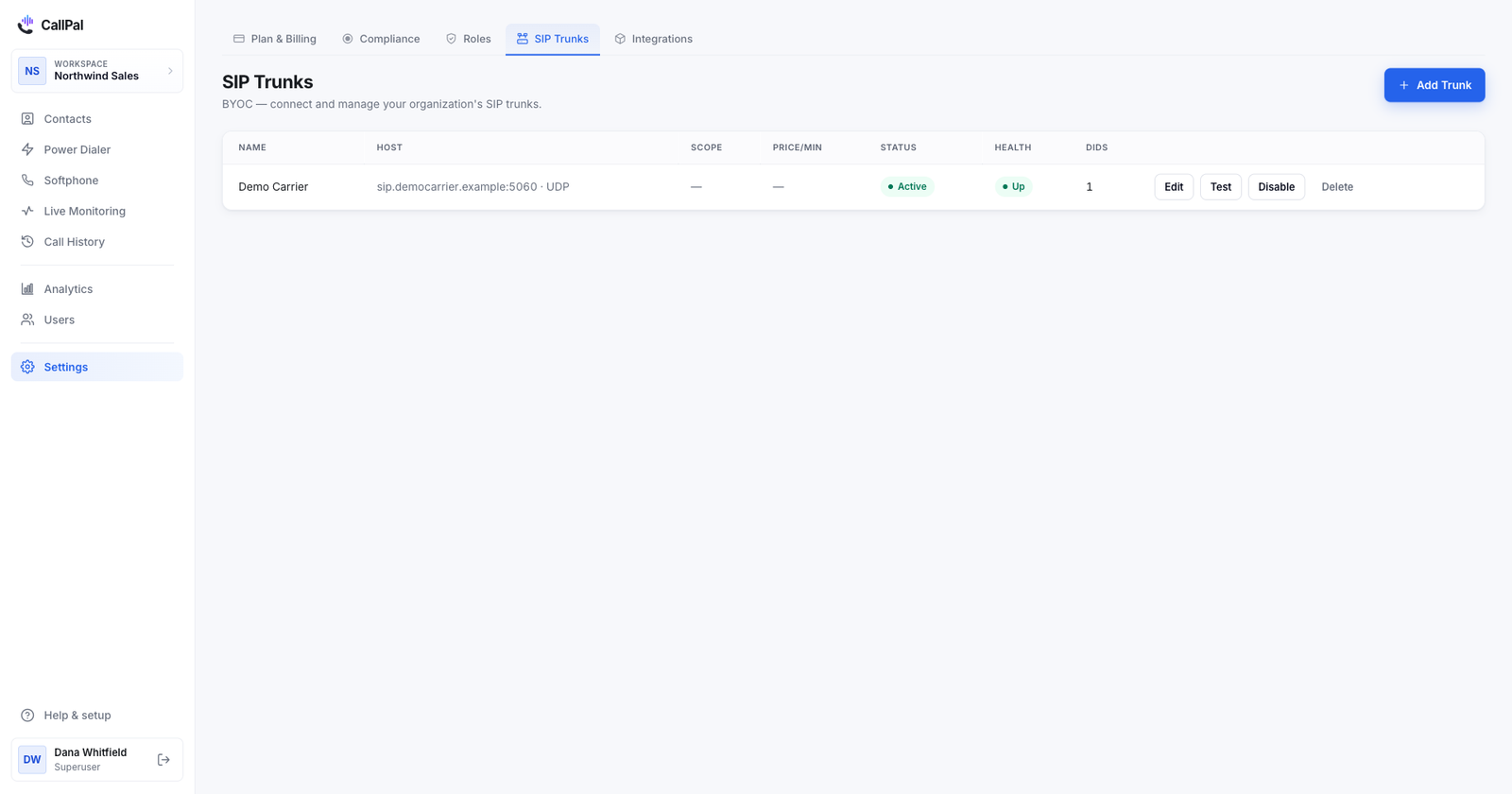
You size the channel limit, and you decide what happens when the carrier has a bad day. The standard answer is a second trunk with a different provider, ranked below the first, so a registration failure moves traffic rather than stopping it. That is the second row in the screenshot below.
Choosing a carrier
For an outbound sales team the shortlist is short and the criteria are unglamorous:
- Termination rates for the countries you actually call. A great US rate is irrelevant if a third of your list is in the UK.
- Caller-ID authentication support. For US traffic, ask specifically how they handle attestation and number registration, and what it costs.
- Encryption. TLS for signalling and SRTP for media should be available and, ideally, the default. Unencrypted SIP over the public internet is still common and still a bad idea.
- Channel limits and burst behaviour. What happens on the day everyone dials at once.
- Whether you can leave. Numbers should be portable and the contract should not have a twelve-month tail.
Providers commonly used for this kind of traffic include Telnyx, Flowroute, Bandwidth, DIDWW and VoIP.ms, among many others. Any provider offering standard SIP registration or IP authentication will work — the architecture is deliberately provider-agnostic, which is the point.
The part nobody mentions: caller ID is a policy, not a setting
Once you own the trunk you also own what goes out as caller ID. That is an advantage — you can guarantee every call presents a company number the prospect can call back — and a responsibility, because the same control is what makes caller-ID spoofing possible and unlawful in most jurisdictions.
The rule worth encoding in software rather than policy: the presented number must come from the pool of DIDs attached to the trunk carrying the call, and there must be no configuration in which a rep’s personal number can be presented. CallPal enforces that in the projection it writes into the telephony layer, which is why it has never had a "use my own number" option.
When to stay bundled
BYOC is not automatically correct. Stay bundled if your volume is genuinely low, if nobody on the team wants to own a carrier relationship, if you need inbound routing and IVR that the calling platform provides anyway, or if procurement would rather have one invoice than two. Those are all legitimate, and the difference at 5,000 minutes a month is a rounding error against the cost of the person managing it.
CallPal is BYOC only — we do not resell minutes and there is no shared pool to fall back on. See BYOC & SIP trunks for how trunks are configured, health-checked and failed over, or the platform comparison for where that sits against the bundled alternatives.