CallPal
Do-not-call rules are rarely broken on purpose. They are broken by a list imported without being checked, a "please stop calling me" that a rep noted but nobody acted on, or a campaign started at 9am Eastern that reached California at six in the morning. Each of those is a process gap, and each one counts per call.
This guide turns the US federal rules into something an outbound team can run: what each list is, which calls it covers, the hours you may dial, and a checklist for before a campaign starts.
Three lists decide whether you may dial
- The National Do Not Call Registry, run by the FTC. Consumers add their numbers; telemarketers must keep them off their lists.
- Your internal list. Everyone who has asked your company not to call them again. You are required to keep one, and it applies even to people you have a relationship with.
- State lists. Several states run their own registries with their own rules. A number can be clear federally and still be on a state list.
The National Do Not Call Registry
Who it covers
The registry protects residential subscribers from telephone solicitations. Mobile numbers can be registered too, and the FCC applies the same rules to them (47 CFR 64.1200(c) and (e)). A registration does not expire: it lasts until the consumer cancels it or the number is removed.
Calls to businesses are mostly outside the registry rules. The difficulty is the same one that runs through all of B2B compliance: a "business contact" whose only number is a personal mobile is, for these rules, very likely a consumer’s phone. Treat any mobile number on your list as covered unless you know otherwise.
Getting access
Telemarketers subscribe each year at telemarketing.donotcall.gov. For the year that began 1 October 2025, the first five area codes are free, each additional area code costs $82, and the whole country is capped at $22,626 (FTC). Many teams use a scrubbing service instead, which holds its own subscription and checks your list against it.
Scrub at least every 31 days
The FCC’s safe harbor protects a caller who reaches a registered number by mistake, but only if, as a routine, it uses a version of the registry no more than 31 days old, has written procedures, trains its people, keeps an internal list, and records that it does all of this (64.1200(c)(2)). In practice that means a list imported in September is not safe to dial in November without being checked again.
The exceptions
- An established business relationship. You may call a registered number for 18 months after the person’s last purchase or transaction with you, or for 3 months after they made an inquiry or application.
- Written permission. A signed, written agreement from the person to be called by you.
- A personal relationship between the caller and the person called.
None of these survives a direct request to stop. Once someone tells you not to call, the internal list takes over.
Your internal do-not-call list
Every company that makes telemarketing calls to residential subscribers must keep its own list of people who asked not to be called (64.1200(d)). The rule is specific:
- A written policy, available on demand, for maintaining the list.
- Training for everyone who makes calls on how to use it.
- Record the request when it is made, and honor it within a reasonable time, no more than 10 business days.
- Keep honoring it for 5 years.
- Identify yourself. The caller must give their name, the company’s name and a number or address where it can be reached.
Most requests arrive in the middle of a call, from someone who will not fill in a form. The process that works is the one a rep can complete before they hang up. Anything that depends on a note being read by someone else later is how the 10 days run out.
The internal list is keyed to the person’s number, not their CRM record. The same person can appear twice in a CRM, return on the next import as a new record, or be dialed by hand. If your list lives on the contact record, all three bypass it.
Calling hours
Federal rules prohibit telephone solicitations to residential subscribers before 8 a.m. or after 9 p.m., local time at the called party’s location (64.1200(c)(1)). The FTC’s Telemarketing Sales Rule sets the same window. The time that counts is the person you call’s, not yours.
States can be stricter. Florida, for example, limits commercial telephone solicitations to 8 a.m.–8 p.m. in the called person’s time zone, and to three calls in 24 hours on the same subject, from any number (Fla. Stat. 501.616). Other states set their own windows, and some restrict Sundays or holidays. Check every state on your list.
The calling hours checker shows the local time in every US time zone right now against the federal 8 a.m.–9 p.m. window. It does not apply state rules like Florida’s, so check those separately.
Area code is not location
A mobile number keeps its area code when its owner moves, so a 212 number may ring in Denver. The defensible approach is a window that is legal in every time zone you call. For the contiguous United States, 11:00 a.m. to 8:00 p.m. Eastern is 8:00 a.m. on the West Coast at the start and 8:00 p.m. on the East Coast at the end, which keeps every caller inside both the federal window and Florida’s. Alaska and Hawaii need their own.
| Callee’s zone | At 11:00 Eastern | At 20:00 Eastern |
|---|---|---|
| Eastern | 11:00 | 20:00 |
| Central | 10:00 | 19:00 |
| Mountain | 09:00 | 18:00 |
| Pacific | 08:00 | 17:00 |
The area code lookup shows which state an area code belongs to and the local time there — useful for a landline, and subject to the caveat above for a mobile number.
What a violation costs
Under the TCPA, a person who receives more than one call in 12 months in violation of the do-not-call rules can sue for up to $500 per violation, and up to three times that if the violation was willful or knowing (47 U.S.C. 227(c)(5)). The FTC can seek civil penalties of more than $50,000 per violation. Because every call counts, a single unscrubbed list is how small teams end up in class actions.
The checklist
Run it before every campaign, and keep a record that you did.
- Know which numbers are consumers. Flag mobiles and anything that is not clearly a business line. Treat them as covered.
- Scrub against the National Registry with a version no more than 31 days old, and keep the date you did it.
- Scrub against the state lists for every state on the list.
- Scrub against your internal list, by number, after every import and before every campaign.
- Document any exception you rely on. An established business relationship needs a date of purchase or inquiry. Written permission needs the signed agreement.
- Set calling hours that are legal in the callee’s time zone, not yours, and use the narrowest state rule you call into.
- Count attempts where a state caps them, such as Florida’s three per 24 hours.
- Give reps a one-step way to add a number to the internal list during the call.
- Restrict who can remove a number. Adding should be easy for anyone; lifting should take an administrator.
- Write it down. A written policy, training records and scrub dates are what the safe harbor asks for.
What CallPal does, and what it doesn’t
The internal list. CallPal keeps a do-not-call list per number, not per contact. Any rep who can place calls can add a number from the contact’s profile while they are still on the phone; only an admin can remove one. Every dial is checked against it, including click-to-call and numbers typed into the softphone, and a campaign skips a listed number and shows it as "Do not call" in the queue. Numbers on the list are stored hashed, not in the clear.
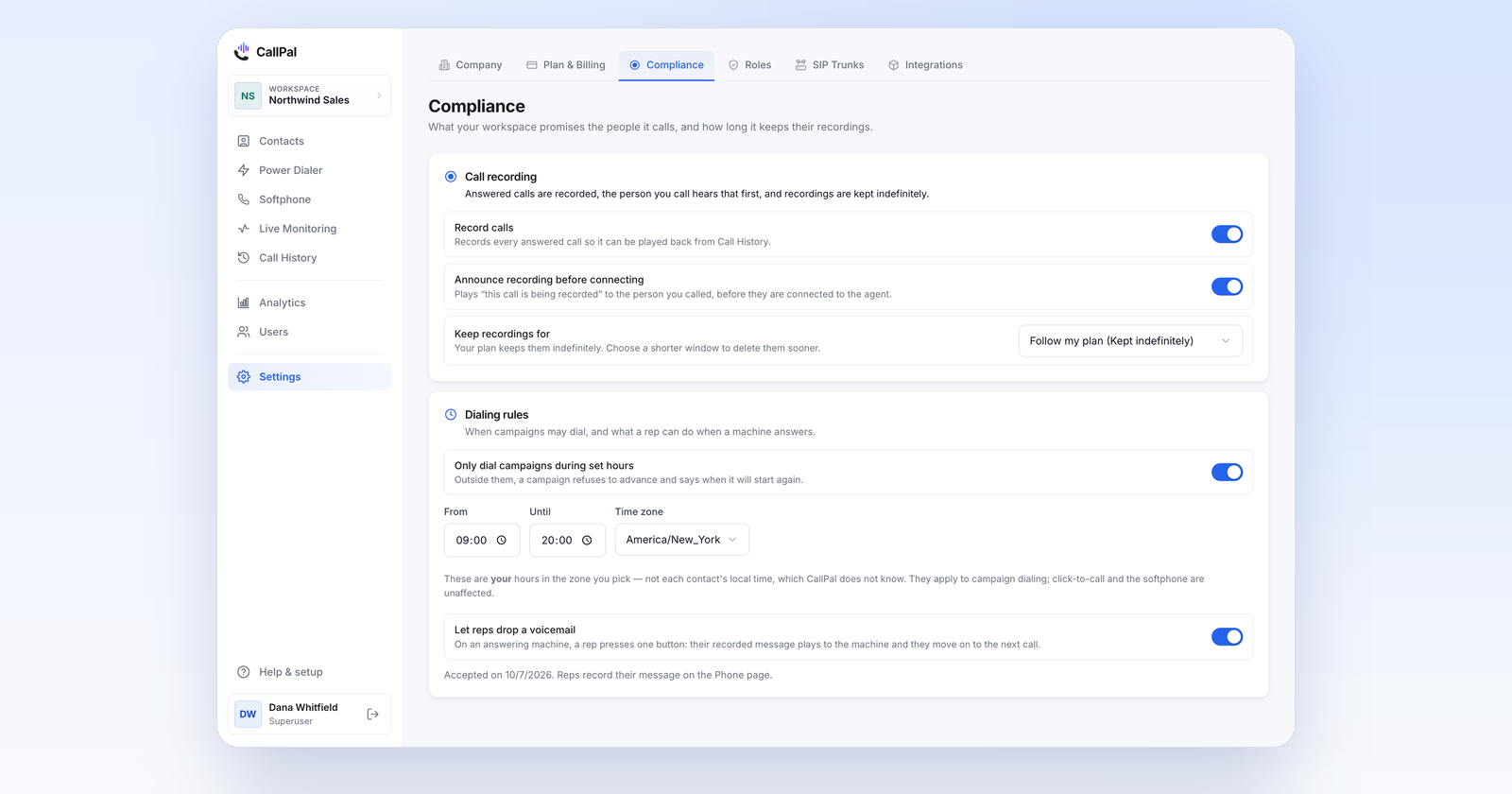
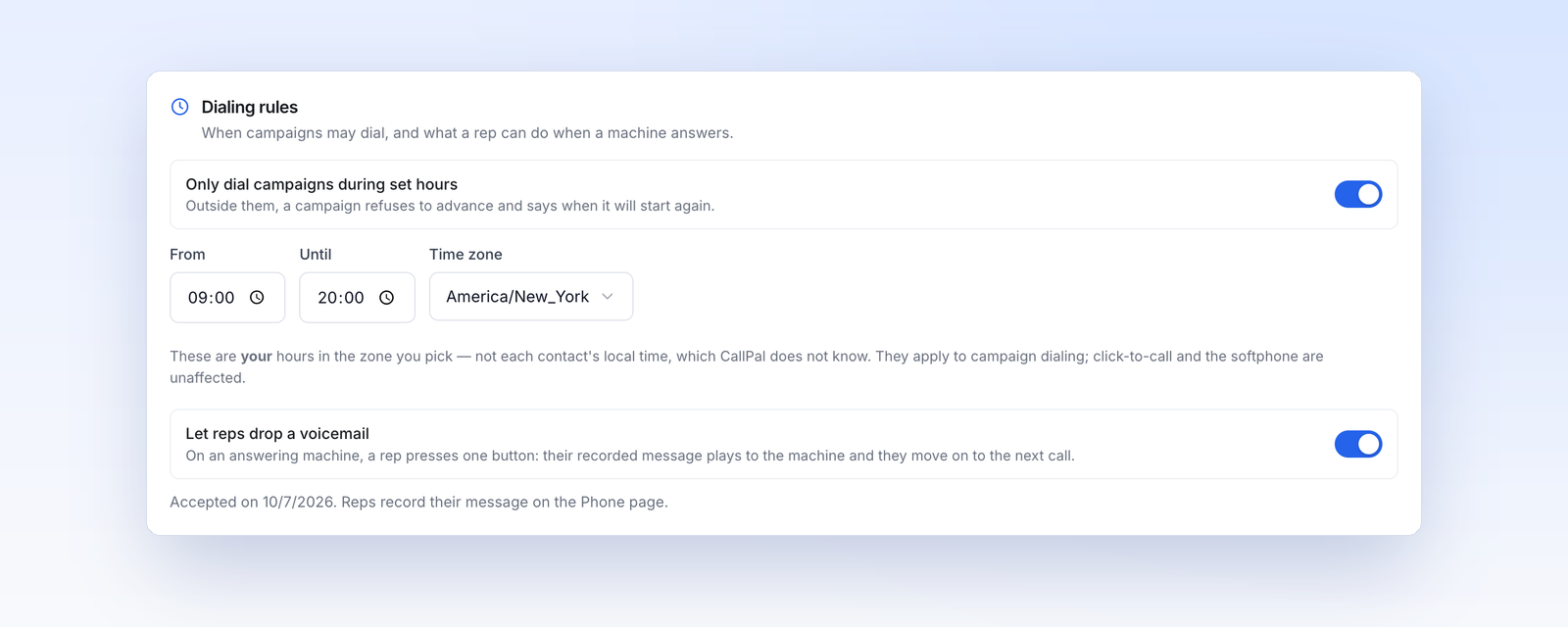
Calling hours. An account owner can limit campaign dialing to a window in one time zone, as in the screenshot above. Outside it, a campaign refuses to advance and says when it will start again. The window is your workspace’s hours, not each contact’s local time, and it applies to campaigns rather than to click-to-call. The settings page says both things in as many words, so set the window as the table above suggests.
What it doesn’t do. CallPal does not scrub against the National Registry or state lists, and it does not know each contact’s time zone. Scrub your list before you import it, and choose a window that is legal at the far end. For the rest of the compliance picture, see call recording laws and voicemail drop.