CallPal
On most outbound lists, more calls end at a voicemail greeting than at a person. Every one of them asks the rep the same question: leave a message or hang up? Leaving one means waiting for the beep and saying, for the thirtieth time that day, the same thirty seconds they said on the twenty-ninth. Hanging up means the prospect never learns who called.
Voicemail drop removes the choice. The rep records the message once, and when a call reaches a machine they press a button: the recording plays to the voicemail and the rep is already on the next call. At forty voicemails a day and half a minute each, that is twenty minutes of every rep’s day handed back, and the message is the best take rather than the most tired one.
It is also a prerecorded message, and prerecorded messages are regulated. This guide covers both halves: how the feature works and what to record, and what US federal law asks of you before you use it.
Voicemail drop, ringless voicemail and auto-drop are different things
Three products get sold under similar names, and the differences matter both for how they behave and for how the law treats them.
| Who decides it is a voicemail | Does the phone ring | Typical use | |
|---|---|---|---|
| Voicemail drop (manual) | The rep, on hearing the greeting | Yes, it is an ordinary call | Sales reps working a list by hand or with a power dialer |
| Auto-drop with AMD | Answering-machine detection software | Yes | High-volume dialers that leave messages with no rep on the line |
| Ringless voicemail | Nobody: the message goes straight into the mailbox | No | Bulk campaigns with no call at all |
Answering-machine detection guesses from the first second or two of audio whether a person or a machine picked up, and it guesses wrong in both directions: a live person hears a recording, or a machine is treated as a person. Manual drop gives up that automation in exchange for never playing a message to someone who answered.
Ringless voicemail is the one that drew the regulator’s attention. In November 2022 the FCC ruled that ringless voicemails to wireless numbers are calls made with a prerecorded voice, and so need the called party’s prior express consent (FCC 22-85). Manual drop is not ringless, because the phone rings and a rep places the call, but the message it plays is still prerecorded. That is the part the law looks at.
How a drop works on a live call
- Record once. The rep records a message of up to a minute and listens back before using it.
- Dial as usual. By hand, from the CRM, or through a power dialer.
- Hear a greeting. The rep waits for the greeting to finish, as they would to leave a message live.
- Press drop. The recording plays to the machine. The rep’s line is released at once and the dialer moves to the next contact while the message is still playing.
- Log it. The call is recorded as a voicemail with the message delivered, so the record says what happened rather than "no answer".
Is voicemail drop legal?
The Telephone Consumer Protection Act regulates calls that use "an artificial or prerecorded voice". A message your rep recorded in their own voice is still prerecorded when it is played back later. In 2026 a federal court let a TCPA suit over sales voicemail drops go forward, noting that "real people can send prerecord messages with their real voice" (Newman v. Abstrakt Marketing Group). Plan on every drop being treated as a prerecorded call.
Mobile numbers need consent
A prerecorded call to a mobile number needs the called party’s prior express consent (47 CFR 64.1200(a)(1)). For telemarketing, the FCC’s rule asks for prior express written consent (64.1200(a)(2)). This applies to every mobile number, including the ones on business cards: a B2B list full of direct dials is mostly mobiles.
The written-consent part is now unsettled. In June 2025 the Supreme Court held that district courts are not bound by the FCC’s reading of the TCPA (*McLaughlin Chiropractic v. McKesson*). In February 2026 the Fifth Circuit held that the statute asks only for prior express consent, oral or written (*Bradford v. Sovereign Pest Control*). That decision binds courts in Texas, Louisiana and Mississippi. Elsewhere, courts may still follow the FCC’s written-consent rule. Unless your lawyer says otherwise, written consent is the standard to plan for.
Residential landlines
A prerecorded call to a residential line that includes an advertisement or is telemarketing needs prior express written consent under the FCC’s rule (64.1200(a)(3)). Separately, the FTC’s Telemarketing Sales Rule bars prerecorded telemarketing messages to consumers without the consumer’s signed written agreement.
Business landlines
The TCPA’s consent rules for prerecorded calls cover mobile and residential lines (and emergency and hospital lines), not ordinary business landlines, and the Telemarketing Sales Rule exempts most calls to businesses (16 CFR 310.6(b)(7)). A company’s main line or a desk phone on its switchboard is the most permissive case. The difficulty is knowing which of your numbers are really business landlines.
What every message must say
Whoever you call, a prerecorded message must state clearly, at the beginning, the identity of the business calling, and during or after the message a telephone number for it (64.1200(b)). A telemarketing message to a consumer may also need an automated opt-out and a toll-free number for it. This is the easiest rule to follow: open with your name and company, and say your number.
| Number you are calling | What federal rules ask of a prerecorded sales message |
|---|---|
| Mobile (consumer or business) | Prior express consent; written under the FCC’s rule for telemarketing |
| Residential landline | Prior express written consent for telemarketing; the FTC also wants a signed agreement |
| Business landline | No TCPA consent rule for prerecorded calls; identification and callback number still apply |
| Any number | Business identified at the start, callback number stated |
Writing a message that gets a callback
A dropped message is played to everyone, so it cannot say the prospect’s name or company. That rules out the "Hi Sarah, saw that Acme just…" opener, and it is the main thing to design around. What works instead:
- Name and company first. The law asks for it, and it is also what a listener needs to decide whether to keep listening.
- Under 30 seconds. Long messages get deleted before the number. Twenty to twenty-five seconds is enough for one idea.
- One reason to call back. Not three. Pick the one most of your list cares about.
- The number twice, slowly. Once in the middle, once at the end, digit groups separated. Nobody has a pen ready the first time.
- Sound like your live voicemails. Record standing up, at your normal pace, in a quiet room. A polished read sounds like an ad.
- No false familiarity. "Returning your call" or "following up on our conversation" when there was none gets a callback once and a complaint after.
Five voicemail scripts
Each one runs about 20–25 seconds read at a natural pace. Every one opens with a name and a company and gives a number, because the rule above applies to all of them. Swap in your own details; the numbers below are fictional.
To write your own for a different situation, the voicemail script generator times each message as it would be read aloud.
1. The first touch
Hi, this is Dana Whitfield from Northwind Sales. I work with operations leads at mid-sized logistics companies on cutting the time their teams spend on carrier paperwork. If that’s on your list this quarter, I’d like fifteen minutes. My number is 415 555 0100. Again, Dana at Northwind, 415 555 0100.
About 22 seconds
2. After an email
Hi, it’s Dana Whitfield at Northwind Sales. I sent a short email this morning with one idea on carrier costs. No need to call back if the email covers it. If it’s easier to talk, I’m on 415 555 0100. That’s 415 555 0100. Thanks.
About 18 seconds
3. An inbound lead
Hi, this is Dana Whitfield from Northwind Sales, calling because you asked about a demo on our website. I’ve got time tomorrow and Thursday. Call me back on 415 555 0100, or reply to the confirmation email and pick a slot there. Again, 415 555 0100.
About 20 seconds
4. An existing customer
Hi, it’s Dana Whitfield from Northwind Sales, your account manager. Your plan renews next month and I want to make sure it still fits how your team works. Give me a call on 415 555 0100 when you have ten minutes. That’s 415 555 0100. Thanks.
About 20 seconds
5. The last try
Hi, this is Dana Whitfield at Northwind Sales. I’ve tried you a few times about carrier costs, and I don’t want to keep filling your voicemail, so this is my last message. If the timing is better later in the year, I’m on 415 555 0100. All the best.
About 20 seconds
One message per rep means one script at a time. Most teams record the first touch and re-record when a campaign changes. For more on the live side of the call, see cold calling scripts.
When to leave a live message instead
- Your biggest accounts. A message that names the person and their company beats any recording. Spend the thirty seconds where the deal size justifies it.
- Numbers you have no consent for. If the list is consumers on mobiles and you lack consent, the drop is the risk, not the time saved.
- After a real conversation. Once you have spoken to someone, a generic message reads as a step backwards.
How to tell whether it is working
Count callbacks per hundred dropped voicemails, by message. Re-record, run the new message for two weeks, and compare. The number will be small, so judge on several hundred drops, not a day’s worth. If calls are logged to your CRM with a voicemail outcome, the count is a filter rather than a spreadsheet. The outbound sales KPIs guide covers which other numbers to watch alongside it.
Voicemail drop in CallPal
Voicemail drop is off until an account owner turns it on, and turning it on means accepting a short statement: that your organization has the consent the law requires, that every message identifies your business and gives a callback number, and that you, not CallPal, are responsible for complying. CallPal keeps a record of who accepted it and when.
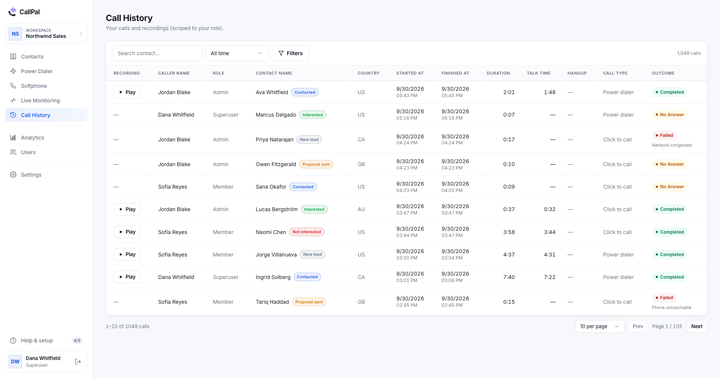
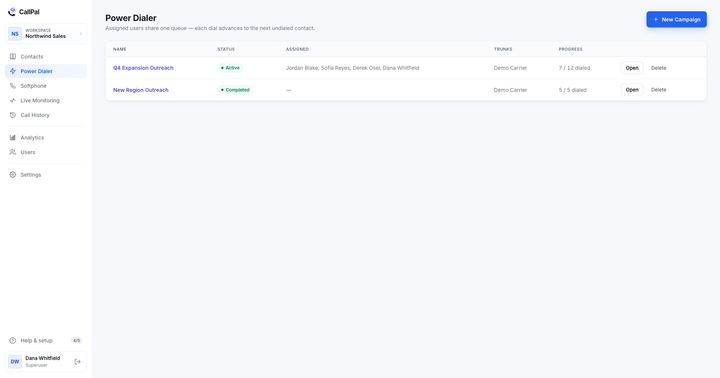
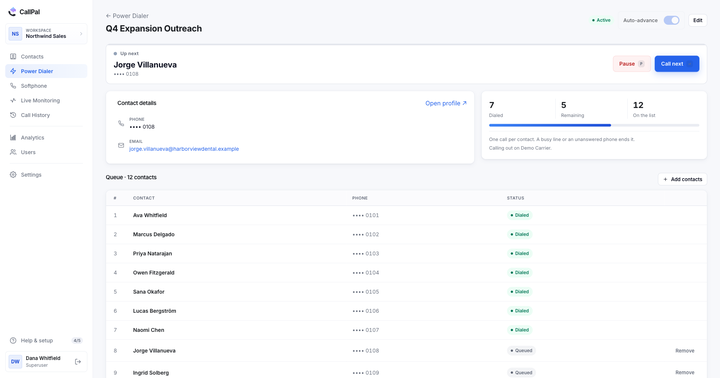
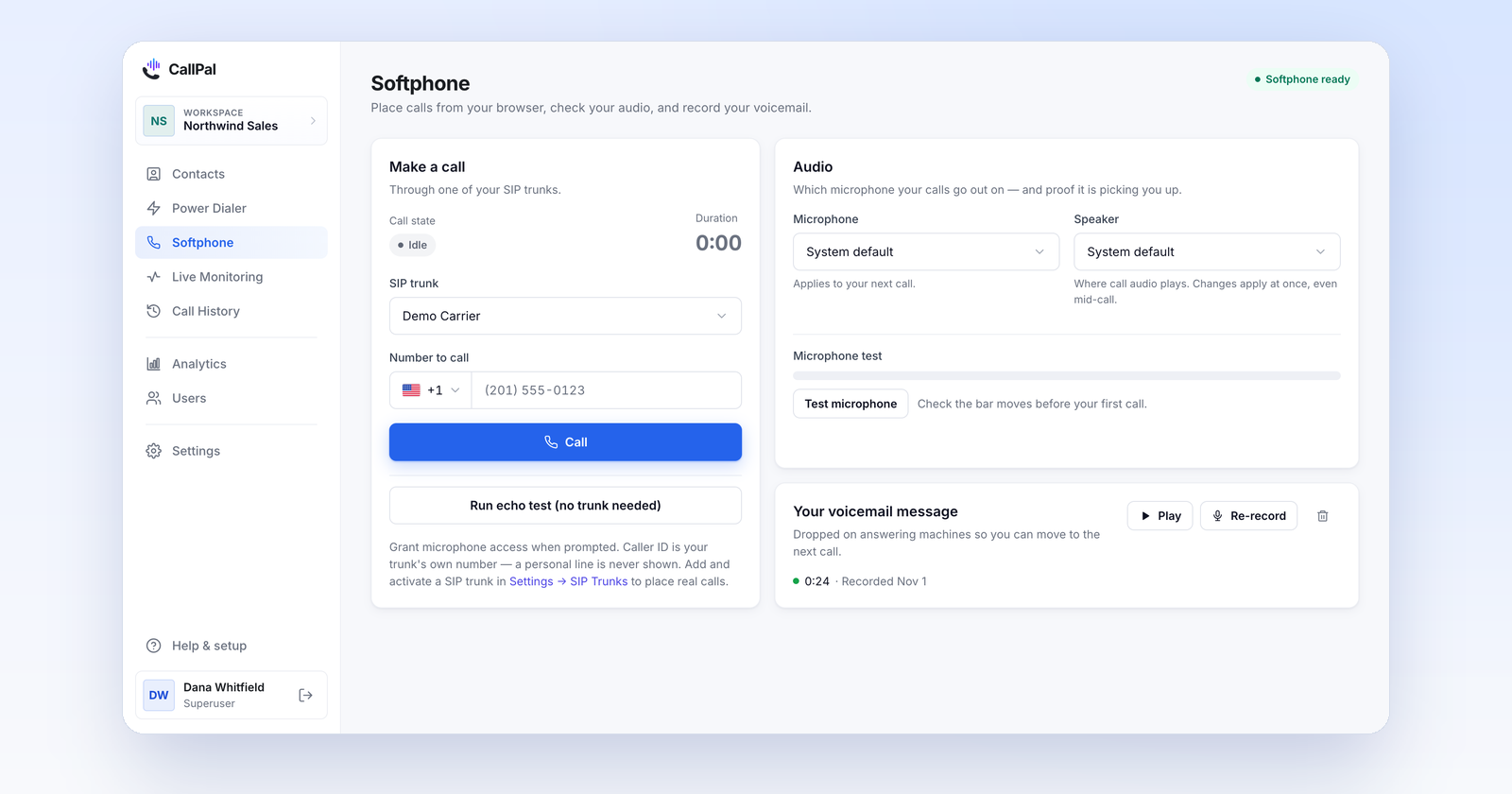
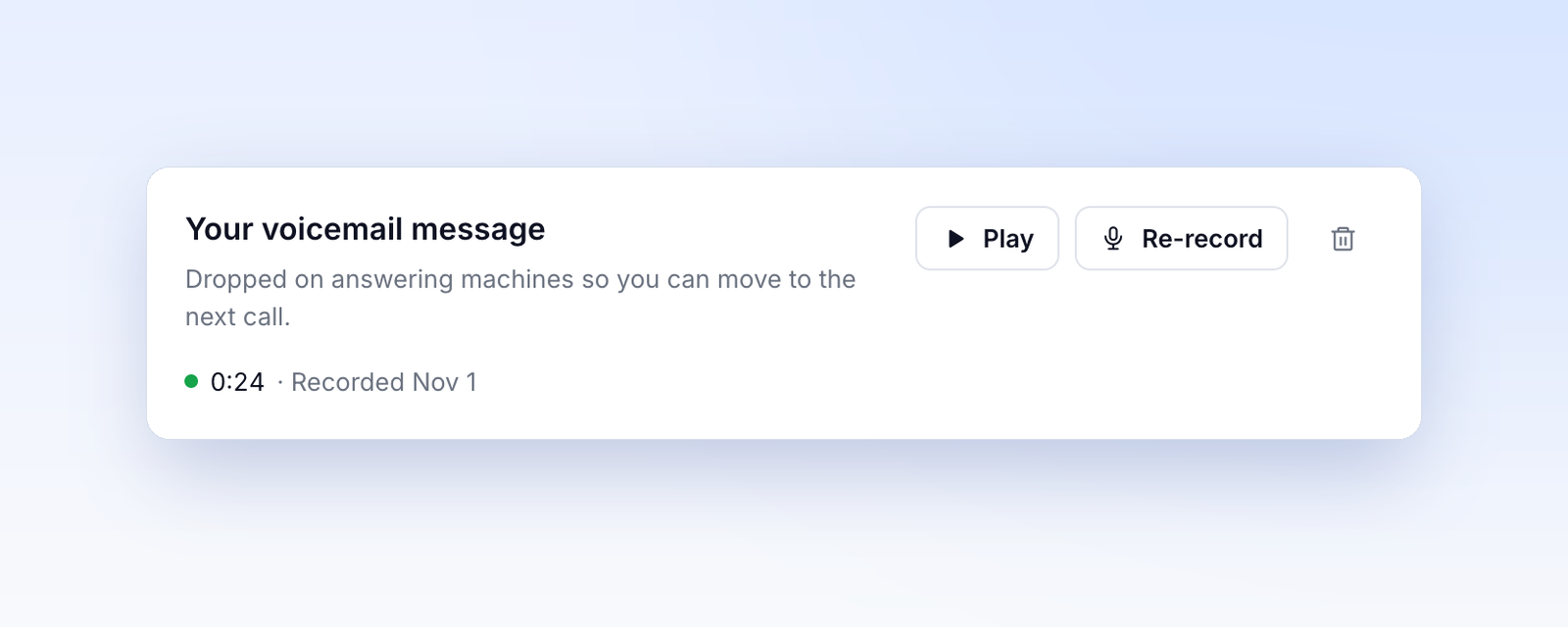
Once it is on, each rep records their own message on the Softphone page, up to 60 seconds. The Drop voicemail button appears on any answered call, whether from click-to-call, quick dial or a power dialer campaign. Detection is manual: no software guesses whether a person or a machine answered; the rep decides. When the rep presses it, their line is released at once, the dialer moves on, and the message plays to the machine. If you record calls, the message is in the recording too. Call history shows the call as Voicemail dropped, or Voicemail cut short if it ended before the message finished, and the call is logged to your CRM like any other.